

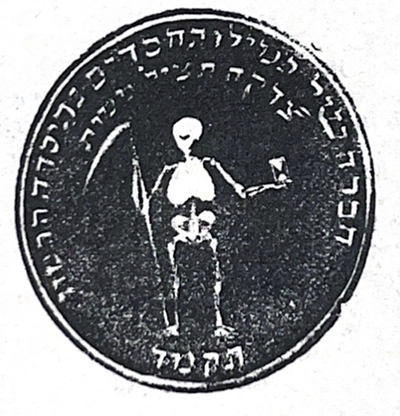
The original seal of the Hebrew Benevolent Society of Charleston, from a pamphlet by Rabbi Barnett A. Elzas in the College of Charleston Special Collections. Elzas discovered the long-lost seal, and thereby the true age of the Society, in 1903. The seal depicts a skeleton holding an hourglass, and the Hebrew reads, “Society for Deeds of Loving Kindness,” “Charity Delivers from Death,” and June 25, 1784, the date when the society was established.
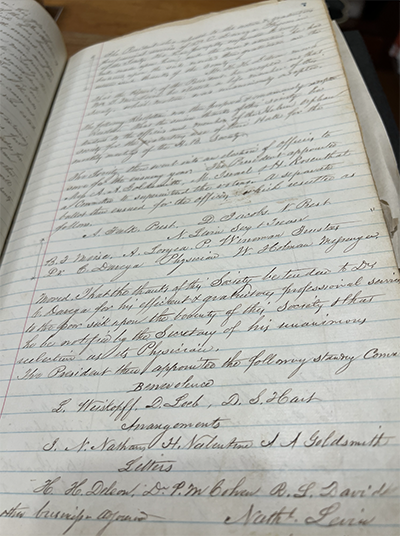
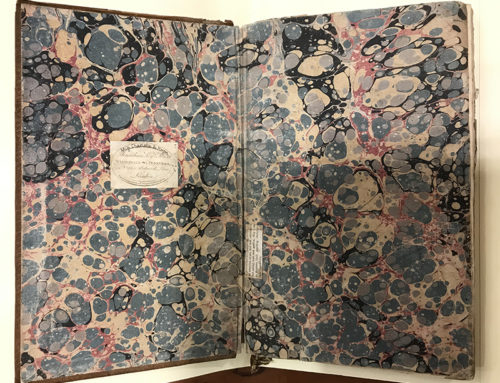
A page from the society’s minute book, held at the College of Charleston Special Collections, that discusses thanking society physician Dr. Columbus Davega for his service.
Elyse Malamud, Undergraduate Student at Northwestern University
Home to one of the oldest Jewish communities in America, Charleston, S.C. is a special place for Jewish history. Through the Pearlstine/Lipov Center for Southern Jewish Culture’s Charleston Research Fellowship, I learned about the history of the Hebrew Benevolent Society of Charleston’s medical philanthropy at Special Collections at the College of Charleston.
In 1784, members of Kahal Kadosh Beth Elohim convened to establish the Hebrew Benevolent Society of Charleston, or the Hebra Gemilut Hasadim (Society for Deeds of Loving Kindness), as it was called.[1] The charitable group primarily cared for sick and deceased Jews in Charleston.[2]
The foundation of the Medical College of South Carolina in 1824 (the first medical school to be established in the South) brought more trained doctors and an improved standard of medicine to Charleston. As a result, the society’s original operations—arranging for laypeople (congregants) to tend to ill community members[3]—no longer sufficiently offered the kind of aid people needed. Thus, the society reorganized and expanded the scope of its philanthropy.[4] It began covering pharmaceutical costs[5] and collaborating with local doctors who served as volunteer society physicians and gratuitously treated those under the society’s care.[6] The doctors were often prominent physicians and well-respected men with a variety of interesting backgrounds—a naturalist, a military surgeon, an animal welfare advocate, a professor, and a mayor, to give some examples.[7] The society physician position existed from at least 1838 until the early 1900s.[8]
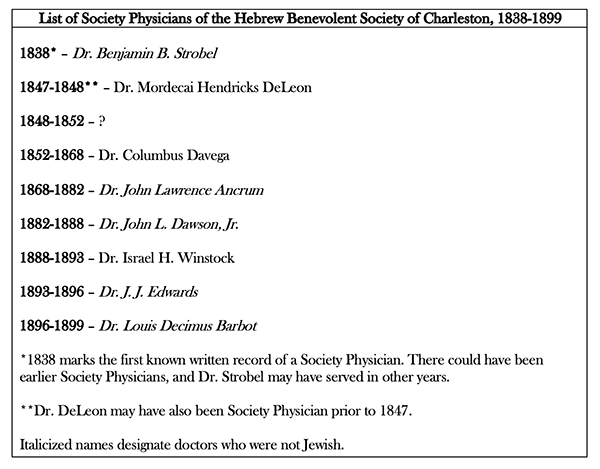 The society’s medical philanthropy and its physicians had a positive impact on Jewish-Christian relations in Charleston. Both Jewish and Christian doctors served as society physicians. They were friends, and they sometimes even collaborated on cases with each other though only one doctor officially held the position at a time.[9] The interfaith nature of the society’s medical philanthropy was publicly recognized and celebrated at the time by the society in the newspaper and on King Street.[10] The society’s medical philanthropy brought Charleston’s Jewish and non-Jewish communities closer together and encouraged interfaith collaboration for the common good.
Over 240 years later, the Hebrew Benevolent Society of Charleston remains an active organization, charitably supporting many causes in the area. The history of its medical philanthropy demonstrates the important impact philanthropy and benevolent societies had on community building for early American Jews.
[1] Thomas J. Tobias, The Hebrew Benevolent Society of Charleston, S.C., Founded 1784: The Oldest Jewish Charitable Society in the United States, An Historical Sketch (Hebrew Benevolent Society of Charleston, 1965), 2-3.
[2] Tobias, The Hebrew Benevolent Society, 3-4; Barnett A. Elzas, The Jews of South Carolina: From the Earliest Times to the Present Day (J. B. Lippincott Company, 1905), 284.
[3] Tobias, The Hebrew Benevolent Society, 4.
[4] Tobias, The Hebrew Benevolent Society, 7-8.
[5] Minutes of Hebrew Benevolent Society, 1867-1923, Hebrew Benevolent Society Papers, Box 1, Folder 1, College of Charleston Special Collections, Charleston, SC, 33, 144, 175.
[6] Minutes, Hebrew Benevolent Society Papers, 7, 32, 140, 165, 172; Tobias, The Hebrew Benevolent Society, 11.
[7] Tobias, The Hebrew Benevolent Society, 8.; E. A. Hammond, “Dr. Strobel’s Account of John J. Audubon,” The Auk, 80 no. 4 (1963): 462.; “Faults and Fractures: The Medical Response to the Charleston Earthquake of 1886,” an online exhibition of the Waring Historical Library, Medical University of South Carolina Library (Charleston: Waring Historical Library, 2011), https://waring.library.musc.edu/exhibits/earthquake/Physicians.php.; James W. Hagy, “From The Crimea To Charleston: The Career of Columbus DaVega,” The Bulletin Kahal Kadosh Beth Elohim, February 1989.; Joe Elmore, “Charleston Animal Society Celebrates 150 Years,” Carolina Tails, February 1, 2024, https://carolinatails.org/charleston-animal-society-celebrates-150-years/.; Theodore Rosengarten, “Diplomacy’s Cruel Sword: Confederate Agents in Pursuit of Recognition,” The Jewish Historical Society of South Carolina, 16 no. 1 (2011): 6.
[8] Tobias, The Hebrew Benevolent Society, 8, 11.; Constitution and By-Laws of the Hebrew Benevolent Society of Charleston 1795-1900 (Charleston: The Daggett Printing Co., 1900), 16-21.
[9] Minutes, Hebrew Benevolent Society Papers, 32.; “A Loss to the City,” June 1893, Winstock, Rosenberg, and Visanska Family Papers, Box 1, Folder 18, College of Charleston Special Collections, Charleston, SC.
[10] Minutes, Hebrew Benevolent Society Papers, 141. Note: the newspaper was likely The News and Courier.
Leave A Comment